For years, commercial lighting rebates followed a simple formula: upgrade to LED, reduce energy use, and collect an incentive. That formula still works. But it’s no longer the full story.
As parts of the country reach LED saturation, utilities are finding it harder to meet energy reduction targets. Much of the easy, one-for-one retrofit work has already been completed. While opportunities still exist, many programs are betting that the next wave of energy savings will come from going beyond the fixture itself.

Traditional rebates are still widespread. In fact, according to our 2026 Lighting Rebate Trends report, they are as strong as ever. But they’re starting to change, with an increasing focus on lighting controls with higher incentive levels, and in some markets, becoming a requirement to qualify for rebates at all.
For contractors, distributors, and building owners, this shift represents a clear opportunity.
Why Controls Are Getting More Attention
At its core, this shift is being driven by the need for deeper energy savings. A standard LED upgrade can reduce energy use by 40–50% compared to fluorescent systems. But as many facilities have already completed those upgrades, the remaining savings opportunities are smaller and harder to capture.
This is where lighting controls come in. Adding networked controls can reduce the remaining energy use by an additional 49%, according to the DesignLights Consortium. Instead of just improving fixture efficiency, controls reduce operating hours, adjust output based on conditions, and eliminate unnecessary energy use altogether.
As a result, utilities are placing greater emphasis on measures that go beyond simple one-for-one fixture replacements. Advanced lighting controls are one of the most effective ways to achieve those deeper savings.
Traditional Controls Still Matter
Today, when many people hear “lighting controls,” they immediately think of advanced networked systems that are becoming popular. But it’s important to remember that traditional controls still can provide increased energy savings. Common examples include occupancy sensors, vacancy sensors, photocells, daylight-responsive controls, time clocks and bi-level controls.
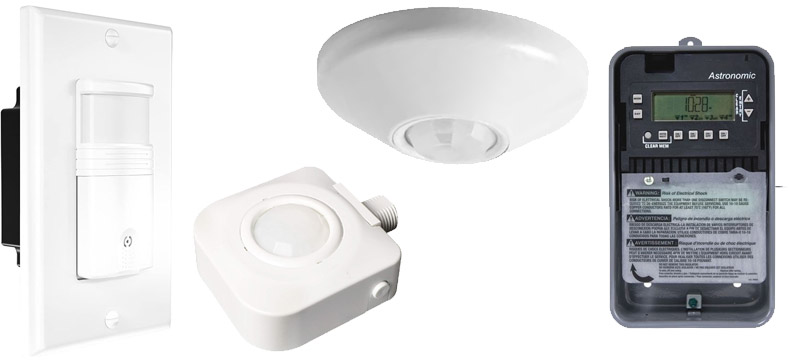
These technologies can deliver meaningful savings in the right applications. A warehouse may benefit from occupancy-based aisle controls. An office may pair LED fixtures with room sensors and daylight dimming. A parking garage may rely on scheduling and occupancy response.
These are practical, proven upgrades that improve performance at a relatively low additional cost and without requiring a fully networked system.
The Rise of Advanced Controls
In addition to traditional controls, more advanced lighting control systems have gained prominence in recent years. These systems are typically more intelligent, allowing devices to communicate and respond dynamically to changing conditions.
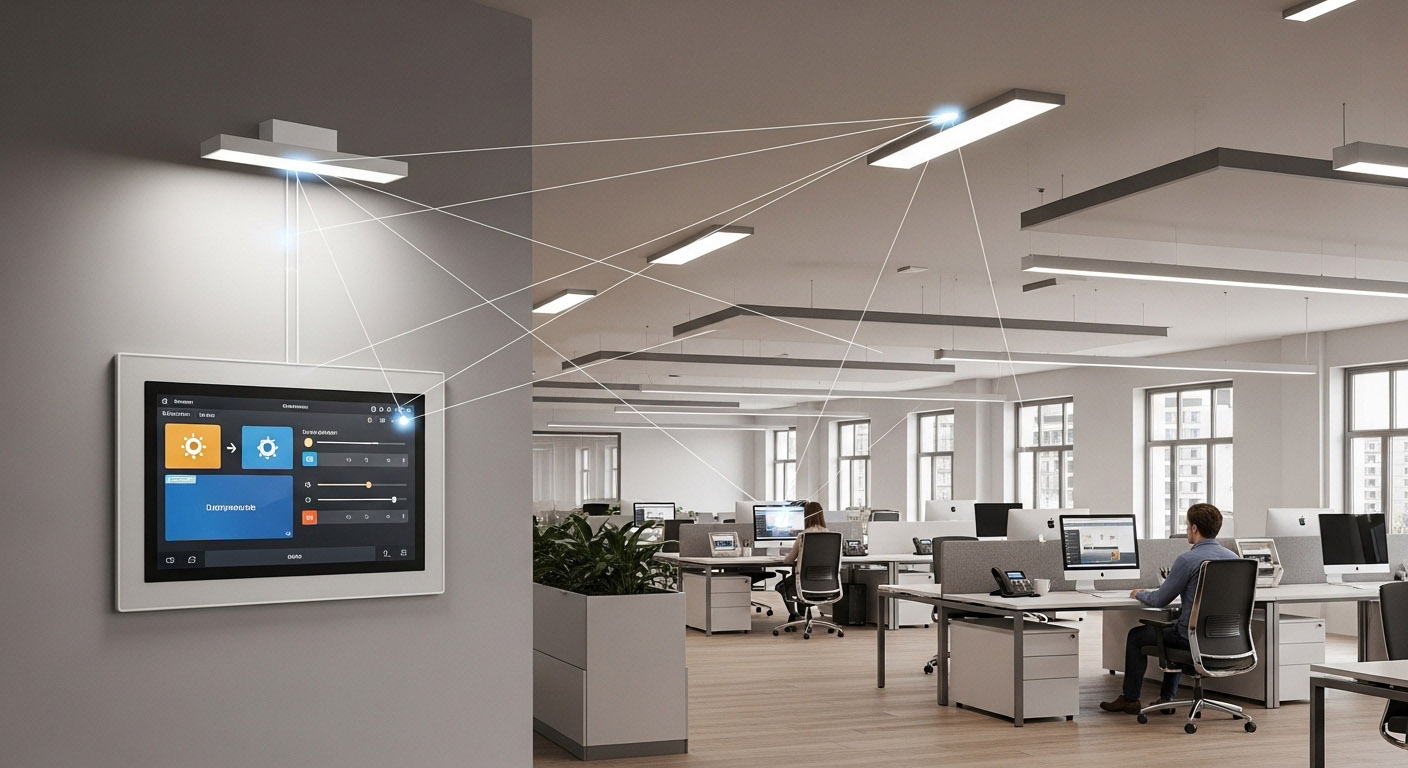
They are often referred to as Networked Lighting Controls (NLC), Luminaire Level Lighting Controls (LLLC), or simply “advanced controls.”
The DesignLights Consortium defines Networked Lighting Controls as systems that combine multiple strategies such as occupancy sensing, daylight harvesting, and scheduling, while enabling devices to exchange digital information.
LLLC is another type within this category which the Lighting Controls Academy defines as a system in which sensors and controllers are installed within individual luminaires, enabling fixture-level control. This approach offers greater responsiveness and flexibility than traditional zoned systems and explains why LLLC is often discussed separately, even though it falls within the broader NLC category.
Rebates for Controls
Traditional controls fit well within prescriptive rebate programs because they are relatively easy to define, verify, and explain. For decades, programs have offered incentives for adding components such as fixture-mounted occupancy sensors, and these incentives are not going away. In fact, incentives for traditional lighting controls increased by 12–20% this year, depending on the measure.
| Type of Standard Control | Average Rebate* |
|---|---|
| Remote Mounted Occupancy Sensors | $30 |
| Wall-box Occupancy Sensors | $27 |
| Photocells | $24 |
| Fixture Mounted Occupancy Sensors | $28 |
| Daylight Dimming Systems | $29 |
Rebates for advanced systems like NLC and LLLC have historically been more complex. While most programs provide incentives for these systems, the structure varies widely. Some offer incentives through custom programs based on projected kWh savings. Others provide per-fixture adders or separate line items based on control type.
In recent years, however, there has been increasing standardization: 63% of NLC incentives are now offered through prescriptive programs, and 40% are paid on a per-fixture basis. Both of these facts make the incentives easier to understand and explain to customers.
More than 200 programs now offer dedicated NLC rebates, a 7% increase over last year, with many others addressing them through custom pathways.
A clear example of how programs are encouraging controls adoption can be seen in Energize Connecticut, which lists controlled and uncontrolled fixture incentives side by side:
Energize Connecticut Rebate Options for 2×4 Troffer
| Fixture Type | Control Type | Rebate Amount |
|---|---|---|
| 2×4 LED Troffer | No controls | $25 |
| 2×4 LED Troffer | Occupancy sensor | $65 |
| 2×4 LED Troffer | Dual sensor | $70 |
| 2×4 LED Troffer | LLLC | $90 |
Instant Rebates for Controls
Another way control rebates are getting easier is that some instant programs are starting to integrate controls in their portfolios. Instant, also called midstream, programs run through participating electrical distributors and typically require little or no rebate paperwork for the end user; the discount is applied at the point of purchase.

Adding LLLC and sensor-integrated fixtures into midstream programs promotes these technologies among smaller-scale customers who typically take advantage of these programs. This type of customers wouldn’t necessarily pursue a full building control system or commissioning process, but may be convinced to upgrade through the instant rebate program.
Rhode Island Energy’s Instant Program for High Bays
| Fixture Type | Control Type | Rebate Amount |
|---|---|---|
| High Bay LED (Very High Output) | No controls | $135 |
| High Bay LED (Very High Output) | Occupancy sensor | $230 |
| High Bay LED (Very High Output) | Dual sensor | $240 |
| High Bay LED (Very High Output) | LLLC | $250 |
For electrical distributors and contractors, this creates an upsell opportunity. For example, with the Rhode Island Instant Program, customers would get almost double the rebate to upgrade to LLLC. The salesperson can quote several options and demonstrate how they’ll not only get a higher rebate for a fixture with integrated controls, but can also help understand the potential additional energy savings.
When Controls Become the Ticket to Any Rebate
In some markets, controls are no longer optional; they are required to receive any incentive at all. While these programs are still in the minority, they are appearing in regions that have historically offered strong rebates for standard lighting upgrades, making the shift more noticeable.
For example, Massachusetts’ Mass Save program has updated its rebate structure so that fixtures only qualify for incentives if they include integral controls. In Oregon, incentives for fluorescent lamp replacements are now only available when paired with advanced lighting controls in the EnergyTrust program. In areas like these, controlled fixtures should be on every quote.
A Growing Opportunity, Not a Replacement
The rise of controls does not mean traditional commercial lighting rebates are going away. Standard fixture and lamp incentives still play an important role, and in many markets they remain the foundation of rebate activity.
What controls add is another valuable opportunity. In some projects, they can significantly increase incentives. In others, they improve energy savings enough to make project economics more attractive. In a mature lighting market, they also provide a practical way to deliver additional value.
That is why commercial lighting controls are worth watching closely. Not because they replace the rest of the rebate market, but because they are becoming one of the most effective ways to get more from it.
How to Take Advantage of the Opportunity
For contractors and distributors, the key to success is to bring controls into the conversation early, and not treat them as an afterthought.
That starts with understanding local program rules. Some utilities offer separate incentives for sensors or control devices. Others provide higher rebates for controlled fixtures, while some specifically incentivize networked or DLC-qualified systems. In certain markets, advanced controls can be the difference between a small rebate and a huge one.

For those looking to take advantage of these opportunities, having access to accurate and up-to-date rebate information is critical. RebatePro for Lighting is designed to help contractors and distributors identify the best rebate opportunities, estimate incentives for specific projects, and stay current as programs continue to evolve across the US and Canada.